The Weight of Luxury: Why High-Caliber Print Collateral Has Become the Most Credible Signal of Premium Brand Value

The Paradox of the Digital Age
There is a certain irony embedded in the current marketing landscape. As digital communication has become universal, effortless, and effectively free, the physical object has acquired a status it has not held in decades. An email costs nothing to send and is treated accordingly. A beautifully produced, letterpress-printed invitation—or a brand lookbook bound in textured linen—arrives as something categorically different. It is an event.
This is not sentiment. It is market logic. When something becomes abundant, its perceived value falls. When something becomes scarce, its perceived value rises. High-quality printed collateral is now scarce in a way it has not been since the desktop publishing revolution of the 1980s made professional-looking materials accessible to virtually every business. The brands that understand this dynamic are using premium print not merely as a communication tool, but as a competitive positioning instrument.
What Luxury Actually Communicates
Luxury, at its core, is a signal. It communicates that a brand has chosen to invest resources—time, money, and creative attention—in a way that exceeds functional necessity. A watch that tells time with the same accuracy as a $20 drugstore model but costs ten thousand dollars is not primarily a timekeeping device. It is a statement about the values of the person wearing it and the company that made it.
The same principle applies to printed collateral. A standard business card printed on commodity stock fulfills its functional purpose: it conveys contact information. A business card printed on 130 lb cotton stock, debossed with a brand mark, and finished with a hand-applied edge color does something entirely different. It communicates that the business behind it operates with intention, precision, and an understanding of quality that extends to every detail of its presentation.
For businesses targeting affluent demographics—wealth management firms, luxury real estate brokerages, private medical practices, high-end hospitality brands, bespoke retail—this signal is not decorative. It is foundational to the brand promise.
The Tactile Argument
Neuroscience offers a compelling explanation for why physical materials carry persuasive weight that digital assets cannot match. Research from institutions including MIT and the Caltech Brain Imaging Center has demonstrated that tactile engagement activates regions of the brain associated with emotional processing and memory encoding. When a prospect holds a beautifully produced piece of collateral, they are not simply receiving information—they are forming an emotional association with the brand that produced it.
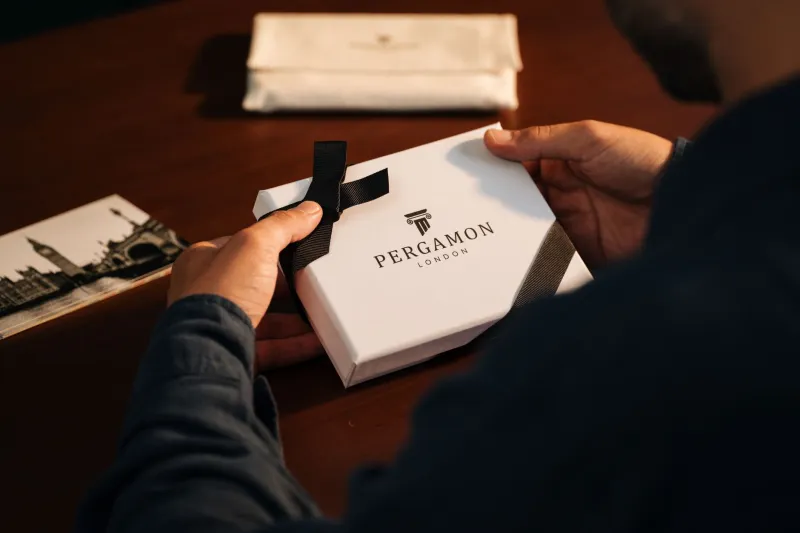
This is the tactile argument for premium print: the physical act of handling a high-quality object creates a neurological connection that outlasts any digital impression. A prospect who receives a custom-foiled welcome package from a private wealth advisor will recall that experience months later in a way that no email sequence, however well-crafted, can replicate.
For businesses in relationship-driven industries where trust is the primary currency, this distinction is not marginal. It is decisive.
The Economics of Perceived Value
One of the most persistent misconceptions about premium print collateral is that its value is proportional to its cost—that the investment required to produce it is justified only for businesses with substantial marketing budgets. This framing misunderstands how perceived value works.
Consider the math. A standard business card costs approximately $0.05 to $0.10 per unit. A premium card on thick cotton stock with foil stamping might cost $0.75 to $1.50 per unit. For a professional who distributes 500 cards per year, the difference in annual expenditure is roughly $700. Yet the impression created by the premium card—and the business it may generate as a result—represents a return that dwarfs that incremental cost.
The same calculus applies across the spectrum of printed collateral. A bespoke client welcome kit for a boutique financial planning firm might cost $35 to $50 per unit to produce. Distributed to 200 new clients annually, that represents a $10,000 investment. For a firm managing assets of $500,000 per client, the lifetime revenue implications of a single retained client—acquired in part because the onboarding experience communicated unambiguous quality—make that investment appear extraordinarily modest.
Premium print collateral is, in this sense, among the highest-leverage marketing investments available to businesses in premium market segments.
Where Digital Falls Short
This analysis is not an argument against digital marketing. Digital channels are essential, measurable, and scalable in ways that print cannot match. But digital communication has a fundamental limitation that is rarely acknowledged openly: it is frictionless, and frictionlessness is the enemy of memorability.
An email can be opened, skimmed, and forgotten in thirty seconds. A beautifully bound capabilities brochure left on a prospect's desk after a meeting occupies physical space, persists in the peripheral vision, and can be picked up and reviewed days or weeks later. It does not require an internet connection, a charged device, or a deliberate decision to open an application. It simply exists, in the prospect's environment, continuing to make its case.
For this reason, premium print collateral functions particularly well as a closing tool—the final, tangible confirmation that a business is exactly as capable and attentive as its digital presence suggests.
The Craft Signal
There is a broader cultural current that reinforces the value of premium print for luxury positioning. The so-called handmade economy—the resurgence of interest in artisanal goods, craft production, and materials with visible provenance—reflects a consumer appetite for objects that carry evidence of human attention and skill. Letterpress printing, hand-finishing, custom binding, and bespoke paper selection speak directly to this appetite.
Brands that incorporate these techniques into their print collateral are not simply producing attractive materials. They are aligning themselves with a set of cultural values—authenticity, craftsmanship, intentionality—that resonate deeply with affluent consumers who have grown skeptical of mass-produced, algorithmic brand experiences.
In this context, the decision to invest in premium print is also a statement about what kind of business a brand chooses to be.
A Standard Worth Setting
The businesses that will define luxury brand positioning over the next decade are not those that spend the most on digital advertising. They are those that understand the full spectrum of tools available to them—and that recognize the extraordinary leverage available in a well-crafted, beautifully produced physical object delivered into the hands of exactly the right person.
Premium print collateral is not a legacy practice. It is a sophisticated, evidence-backed strategy for building the kind of brand perception that drives long-term loyalty, premium pricing power, and referral-based growth. For businesses serious about occupying the upper tier of their market, it is not optional. It is the standard.