Midnight Preflight, Dawn Delivery: The Anatomy of a 48-Hour Rush Order
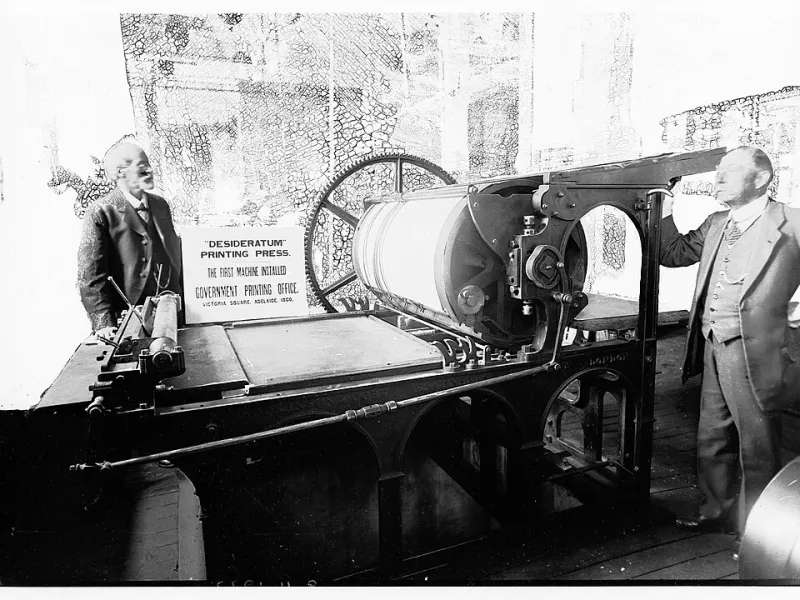
Photo: State Government Photographer, CC0, via Wikimedia Commons
It is 11:47 on a Tuesday night when the file lands in our queue. A Chicago-based software company has just learned its booth graphics were damaged in transit — and the trade show floor opens Thursday morning. Roughly 54 hours from now. What follows is a compressed masterclass in how commercial printing actually works, and why the businesses that understand it get better outcomes from their rush orders.
Hour Zero: Preflight in the Dark
Before any ink touches paper, a prepress technician opens the submitted files and interrogates them. Does the booth banner bleed a quarter inch on all sides? Are the fonts embedded or outlined? Is that hero image 300 DPI at final size, or will it turn to mush when stretched across eight feet of fabric? On this particular night, the answer to that last question is no — the client's logo was supplied as a screenshot pulled from their website.
This is the single most common failure point in urgent print jobs. A raster logo that looks crisp on a phone screen becomes an illegible blur at trade show scale. Our technician rebuilds the mark as a vector file, a fix that costs the client nothing but adds ninety minutes to a schedule with none to spare.
The lesson for businesses: maintain a vector logo library and high-resolution asset folder before you need it. Emergencies amplify every weakness in your file hygiene.
Hours Two Through Twelve: Materials, Plates, and the Paper Chase
With files approved by 1:30 a.m., the next constraint is physical. The client needs retractable banner stands, table throws, and 500 brochures — and the specified cardstock for the brochures sits in a warehouse two states away. A production coordinator calls three regional suppliers before finding a compatible 100-lb gloss text stock that can be here by midmorning.
This is where the difference between a print vendor and a print partner becomes obvious. A vendor quotes what is easy. A partner works the phones at 3 a.m. because your emergency is the assignment.
Hour Eighteen: The Press Check at Dawn
Large-format banners run first, because curing and finishing take the longest. By 6 a.m., a press operator is standing in front of a 64-inch printer comparing a test strip against the approved proof, checking color under D50 lighting. The client's brand blue — a deep navy that photographs misleadingly — has printed with a purple cast. The operator adjusts the profile, reruns the strip, and locks in the corrected settings before the full run begins.
Color management is invisible when it works and catastrophic when it doesn't. A business that insisted on a hard-copy proof, even under deadline pressure, would have caught this shift before the run. One that approved a JPEG on a laptop calibrated to nobody-knows-what might have paid for 54 hours of work and received a banner in the wrong blue.
Hours Thirty Through Forty-Five: Finishing, QC, and the Freight Equation
Brochures print, trim, and fold overnight Wednesday. The banners are heat-cut, hemmed, and fitted to their stands. A quality technician fans every one of the 500 brochures looking for scuffs, roller marks, and misregistration — pulling eleven pieces and replacing them with overflow stock.
Then comes the step businesses most often forget to plan: logistics. Ground shipping from our facility cannot make Thursday morning. The order goes out via overnight priority freight, insured, with a signature requirement, arriving at the convention center loading dock at 7:15 a.m. Thursday. Total elapsed time from panicked email to booth-ready graphics: just over 44 hours.
How to Spec an Emergency Job Right
If your deadline ever becomes our emergency, here is what separates a smooth rush order from a disaster:
- Send print-ready files. CMYK, 300 DPI at final size, quarter-inch bleed, fonts embedded. Ask your designer for a packaged file set, not a flattened PDF screenshot.
- Approve proofs fast and decisively. Every hour of proofing limbo comes straight out of production time. Designate one decision-maker.
- Be honest about the true deadline. "It needs to be there Thursday" is workable. "Sometime before the event" wastes hours we could spend solving problems.
- Know your receiving situation. Loading dock hours, booth number, on-site contact. The best-printed banner in the world is worthless if it circles a convention center with no one to sign for it.
- Build a print buffer. Keep current files for your core collateral with your printer. Reordering in a crisis takes hours; starting from scratch takes days.
Rush printing carries a premium, and it should — it mobilizes people, machines, and freight outside normal rhythms. But the premium buys you speed, not miracles. The businesses that emerge from print emergencies unscathed are the ones that arrived with their files in order, their decisions pre-made, and their expectations calibrated to physics. When the next deadline detonates, we will be here. The more you bring us, the faster we can get you back to business.